When you're looking to book an artist, understanding the financial side of things is super important. Deals can get complicated fast, with talk of guarantees, percentages, and all sorts of other terms. This guide breaks down some common deal structures and what they mean for both the artist and the person booking them. It's all about making sure everyone's on the same page and the money makes sense.
Advance Delivery Requirements
When you're talking about advances in music deals, the publisher or label isn't just handing over cash for nothing. There are usually strings attached, and these are called advance delivery requirements. Basically, it's what you, the artist, have to provide to earn that money. It's not always just about delivering a certain number of songs; sometimes, the quality or licensing status of those songs matters too.
Think of it like this: you might agree to deliver ten songs for your advance. But the deal might also say those ten songs need to be licensed for at least 75% of the statutory rate. This can get tricky, especially with new artists. If an album is released at a lower price point, the mechanical royalty rate you get paid is often cut in half. So, if your deal requires songs licensed at 75% of the statutory rate, but the label only pays 50% of that due to the album's pricing, the publisher might argue they don't owe you the advance, or at least not yet.
It's important to get clarity on how fractional ownership of songs counts. If you co-wrote a song and only own 50% of the publishing, that should count as half a song towards your delivery commitment, not a full song. Most standard contracts don't automatically account for this, meaning you might not get credit for songs you partially own, even though they still earn money.
Here’s a breakdown of common delivery requirements:
- Number of Songs: The most basic requirement is delivering a set number of songs. This number might differ from what's needed to move the contract term forward
- Commercial Release: Some deals require songs to be commercially released on a major label to count towards delivery
- Licensing Percentage: As mentioned, songs might need to meet a minimum licensing rate
- Percentage of Album: If you're a self contained artist who writes all your material, you might need to deliver 100% of the songs on an album to get your advance
It's a good idea to build in protections for falling short of a target. Instead of an all-or-nothing situation, aim for a pro-rata payment. For example, if you're supposed to deliver ten songs and only deliver eight (80%), you should ideally get 80% of the advance, not zero. Publishers will often agree to this, but they usually insist on a minimum delivery threshold, like 50% of the target, below which no payment is made.
Understanding these terms is key to making sure you get paid fairly for your work. It's all part of the bigger picture when discussing merchandising agreements.
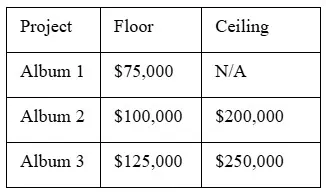
Floor Ceiling
When you're talking about advances for artists, especially in music or publishing, you'll often hear about a "floor" and a "ceiling." Think of it like a safety net and a lid on how much money you can get for your next project, like a new album or book.
Basically, the floor is the minimum amount you're guaranteed to receive as an advance, no matter what. Even if your previous work didn't sell as well as expected, you'll still get at least this amount. It's there to give you some financial security and encourage you to keep creating.
On the other hand, the ceiling is the maximum amount you can receive. This is usually tied to how well your previous work performed. If your last album was a massive hit, you might get an advance closer to the ceiling. It's a way for the label or publisher to limit their risk while still rewarding success.
Here’s a simple way to look at it:
- Floor: The lowest possible advance you can get
- Ceiling: The highest possible advance you can get
These numbers are usually negotiated upfront in your contract. They're calculated based on a formula, often a percentage of your previous earnings, but they're adjusted so they don't go below the floor or above the ceiling. So, if the calculation based on your sales lands somewhere in the middle, that's what you get. But if the calculation suggests you should get less than the floor, you still get the floor amount. And if it suggests you should get more than the ceiling, you only get the ceiling amount.
It's all about balancing risk and reward. The floor protects the artist from a bad sales period, while the ceiling protects the company from paying out too much if sales are unexpectedly huge, though often the ceiling is set quite high for successful artists.
For example, let's say an artist's contract states:
Promoter Profit Deal Step by Step Guide
Alright, let's break down how a promoter profit deal actually works, step by step. It sounds complicated, but it's really about figuring out who gets what after all the costs are covered. Think of it as a way to share the risk and the reward.
First off, you need to know the total money brought in from ticket sales. That's your Gross Box Office Receipts, or GBOR. Then, you figure out the facility fee, which is usually a per-ticket charge for using the venue. Multiply that fee by the number of tickets sold to get your Gross Facility Fee.
Next, you subtract that Gross Facility Fee from the GBOR. This gives you what's called the Adjusted Gross. From there, you need to account for sales tax. If the tax is already included in the ticket price, you'll divide the Adjusted Gross by (1 + tax rate) to find your Net Box Office Receipts (NBOR).
Now, it's time to list all the expenses. This includes everything from venue costs and marketing to the artist's guarantee. Once you have your total expenses, you can calculate the promoter's profit. This is usually a percentage of the total expenses, as agreed upon beforehand.
Here’s a simplified look at the numbers:
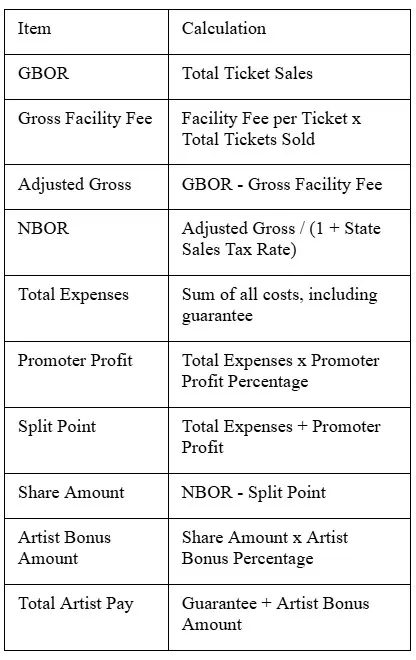
So, the split point is the amount of money that needs to be made before any extra bonus money is paid out. Anything above that split point is then shared between the artist and the promoter, usually with the artist getting a bigger cut, like 85% or more. This bonus amount is added to the artist's initial guarantee, giving you the total amount the artist gets paid.
It's all about transparency. Both the artist and the promoter need to agree on how these numbers are calculated. Make sure every expense is accounted for and that the percentages for profit and bonus splits are clearly defined in the contract. This avoids any confusion later on.
Payment Schedule
When you're talking about how artists get paid, the payment schedule is a really big deal. It lays out exactly when and how you'll receive your money. This isn't just about getting paid; it's about managing your cash flow and knowing what to expect.
Different types of deals have different payment structures. For instance, in a commission agreement, you might get a portion of the payment upfront when the contract is signed, and the rest when the work is finished and delivered. It’s pretty common to split it this way, maybe 50% at the start and 50% at the end, but you can negotiate that. You'll want to be clear about the total cost, including any taxes or shipping, and how much of that comes at each stage.
For advances, especially in music publishing or record deals, the schedule can be more complex. You might get a chunk when you sign, another chunk when you deliver a certain number of songs or recordings, and then the rest as you hit other milestones. It’s not unusual to see payments broken down like this:
- On Signing: A percentage of the total advance is paid when the agreement is finalized
- On Delivery of Milestones: Payments are made as you meet specific targets, like delivering a set number of songs or completing a recording session
- On Release: Sometimes, a portion of the advance is tied to the actual release of the work
It’s also important to understand the concept of accounting delays. This is the time a label or publisher has to calculate and report sales and royalties. So, even if a sale happens in January, the money might not show up on your statement until months later, depending on the reporting frequency (monthly, quarterly, or half yearly) and the agreed upon delay.
The specifics of your payment schedule are usually laid out in the contract. Always read this section carefully and make sure you understand when payments are due and what conditions need to be met for those payments to be released. Don't be afraid to ask questions if anything is unclear.
Royalty Style Deal
A royalty style deal is pretty common in the music industry, and it works a bit differently than a profit share. Instead of splitting the profits after all costs are paid, you get a set percentage of the money that comes in, right from the top. This means you get paid based on gross revenue, not net profit.
Think of it like this, if a song makes $100, and your royalty rate is 10%, you get $10. The label or distributor then covers their costs from the remaining $90. This can be good because you get paid sooner, but it also means you might get less overall if the costs are really high.
Here’s a breakdown of how it often plays out:
- Revenue Streams: The percentage you get can vary depending on where the money comes from. For example, you might get a different rate for digital streams versus physical sales, or even for different countries
- Recoupment: The agreement will also say what percentage of upfront costs can be taken out of your share. Sometimes it's a flat rate, other times it differs by cost type
- Territory: The deal might specify a geographic area where the royalty applies, like worldwide or just a specific country
- Exclusivity: Often, you'll be tied to one label or distributor for a certain period or until a specific number of projects are completed
It’s important to understand that these deals aren't always straightforward. The percentages can be all over the place depending on the services provided, the advance amount, and who has more bargaining power. For instance, physical sales might have a lower royalty rate because they involve more complex logistics than digital sales. Getting a clear picture of these different rates is key to understanding your potential earnings. You can find more information on how artists earn royalties by licensing their artwork.
The specifics of a royalty deal can get complicated quickly. Always read the fine print to know exactly how your earnings are calculated and what costs might be deducted before you see your share.
Consignment Contract
A consignment contract is pretty common in the art world. Basically, you, the artist, give your artwork to a gallery or a shop to sell for you. You're the "consignor," and the place selling your stuff is the "consignee." They take a cut, called a commission, and give you the rest when your piece sells. If it doesn't sell, you usually get it back.
It's super important to have everything in writing. This protects both you and the gallery. You'll want to make sure the contract clearly states:
- What's being sold: A detailed list of your artworks, including descriptions and maybe even photos
- The price: The agreed-upon retail price for each piece
- The commission rate: How much the gallery gets. This is often negotiable, with splits like 50/50 or 60/40 (artist/gallery) being common. Try not to let them take more than half
- Payment terms: When you can expect to be paid after a sale. Usually, it's within 30 days, but confirm this
- Duration of the agreement: How long the gallery has to sell your work
- Return policy: What happens to unsold pieces and when they'll be returned to you
- Discount policy: Whether the gallery can offer discounts, and if so, who covers the cost of that discount
You should also think about including a clause that protects your ownership of the artwork until you're fully paid. This is especially helpful if the gallery runs into financial trouble, as it can prevent creditors from claiming your unsold pieces. It's a good way to shield your work.
When you hand over your art, get a signed inventory list back. This confirms they received it and it's now their responsibility. It's a good idea to check out the gallery's reputation and sales history before signing anything. You can find templates and advice on consignment agreements at places that help artists manage their business, like artist resources.
License Agreements
When you grant someone permission to use your artwork for a specific purpose, like on merchandise or in an advertisement, you're entering into a license agreement. Think of yourself as the licensor, giving the rights, and the other party as the licensee, receiving them. It's a common way artists earn money beyond just selling original pieces.
This type of deal outlines exactly how and where your work can be used, for how long, and what you get paid.
Key things to nail down in a license agreement:
- Scope of Use: Be super clear about where and how the licensee can use your art. Is it for t-shirts only? A specific ad campaign? A particular region?
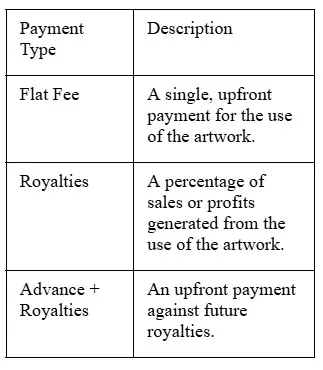
- Payment Terms: This covers how much you'll be paid. It could be a one time fee, regular payments, or a cut of the profits (royalties). Specify when and how you expect to get paid
- Duration: How long does the license last? Make sure it's not set to automatically renew if you don't want it to
- Termination Clause: What happens if you or the licensee want to end the agreement early? Having this clearly defined prevents future headaches
Here’s a simple breakdown of payment structures you might see:
It's important to remember that a license agreement is about granting permission, not selling ownership. You retain the rights to your work, but the licensee gets to use it under the agreed upon terms. This distinction is pretty important for protecting your creative assets.
Commission Agreements
When you agree to create a custom piece of art for someone, that’s a commission agreement. It’s different from selling something you’ve already made because the client is commissioning you to make something for them. This means you need to be super clear about what they want and what you’re going to do.
It’s all about setting expectations upfront.
Here’s a breakdown of what you should cover:
- The Vision: Get as many details as possible from the client about what they’re looking for. What size? What style? Any specific colors or subjects? The more you know, the better you can deliver
- The Process: Outline the steps you’ll take. Will you show them sketches first? How many revisions are allowed? When will they see progress updates? Be specific about timelines for each stage
- The Payment: Agree on the total cost. Usually, this is split into a deposit when you start and the rest upon completion. Make sure to include costs for materials, shipping, and any taxes
- The Delivery: How will the final piece be delivered? What’s the process for final approval? What are the shipping arrangements?
- The 'What Ifs': What happens if the client decides to cancel the project halfway through? You should discuss a 'kill fee', a payment that covers your work so far if the project gets cut short
Think of it like this:
A commission agreement is basically a roadmap for a custom art project. It ensures both you and the client know where you're going, how you'll get there, and what happens if someone takes a wrong turn.
This kind of agreement protects both parties. For you, it means you get paid for your time and effort. For the client, it means they get the artwork they envisioned.
Goods or Services